
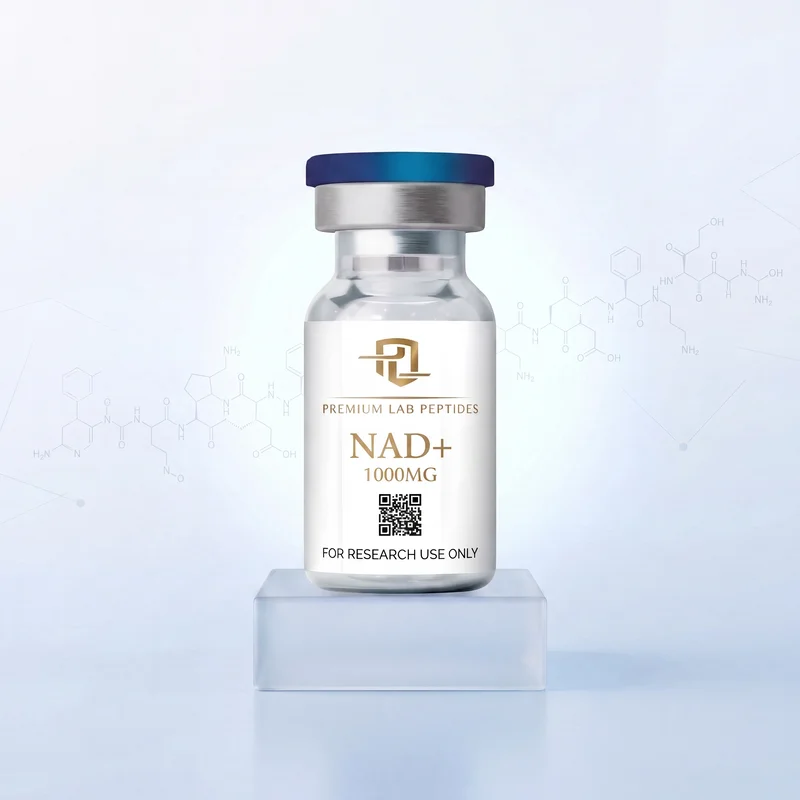
NAD+ 800mg
NAD+ 800mg — for in vitro laboratory research use only.
Product Overview
NAD+ is a pharmaceutical-grade research compound supplied as a lyophilized powder. Each batch undergoes independent third-party testing with a Certificate of Analysis (COA) available on request.
Specifications
| CAS Number | 53-84-9 |
| Molecular Formula | C21H27N7O14P2 |
| Molar Weight | ~663.43 g/mol |
| Classification | Coenzyme; naturally occurring dinucleotide (nicotinamide adenine dinucleotide) |
| Appearance | White to off-white lyophilised powder (typical presentation) |
| Solubility | Soluble in water |
| Storage | Store lyophilised powder desiccated and protected from light at -20°C. Once reconstituted, protect from light, keep cold, and use promptly. |
| Shelf Life | Typically stable for up to 24 months when stored lyophilised, desiccated, and protected from light at -20°C — confirm against the specific batch's Certificate of Analysis. |
Description & Mechanism of Action
NAD+ (nicotinamide adenine dinucleotide) is a coenzyme present in all living cells, formed from two nucleotides joined by a pyrophosphate bond — one bearing adenine, the other nicotinamide. It functions as a mobile electron carrier central to cellular energy metabolism, accepting electrons during glycolysis and the tricarboxylic acid cycle and being reduced to NADH, which then donates electrons to the electron transport chain to drive oxidative phosphorylation and ATP synthesis. Beyond this redox role, NAD+ is an essential co-substrate for NAD+-dependent enzymes including the sirtuin family (SIRT1-7), which use NAD+ to remove acetyl groups from target proteins in processes linked to DNA repair, mitochondrial biogenesis, and cellular stress resistance, and poly(ADP-ribose) polymerases (PARPs), involved in DNA damage repair. Cellular NAD+ levels are reported to decline with age, which has driven substantial research interest in restoring NAD+ levels — either through direct administration or via precursor compounds such as NMN and NR — as a strategy for studying cellular metabolism, DNA repair capacity, and age-related functional decline.
Applications in Research
- Studying redox metabolism, glycolysis, and oxidative phosphorylation
- Sirtuin (SIRT1-7) activity and NAD+-dependent deacetylation research
- DNA damage repair research via the PARP pathway
- Cellular aging and mitochondrial biogenesis research models
Handling, Reconstitution & Stability
- Handle as a hygroscopic powder; open vials and weigh under dry conditions where possible
- Reconstitute with sterile water or bacteriostatic water, adding solvent slowly down the side of the vial
- NAD+ solutions are light- and temperature-sensitive; protect from light and keep cold during handling
- Filter-sterilise (e.g. 0.22 µm) immediately before use if required by your protocol
- Aliquot reconstituted solution and store at -20°C or below; avoid repeated freeze-thaw cycles
Precautions & Notes
- Experimental effects are concentration-, duration-, and model-dependent
- Include appropriate experimental controls to distinguish specific from non-specific effects
- For laboratory research use only — not for human or veterinary use
This product is supplied for in vitro research purposes only. It is not intended for human or animal administration, diagnostic use, or any other purpose. Handle in accordance with good laboratory practice guidelines.