
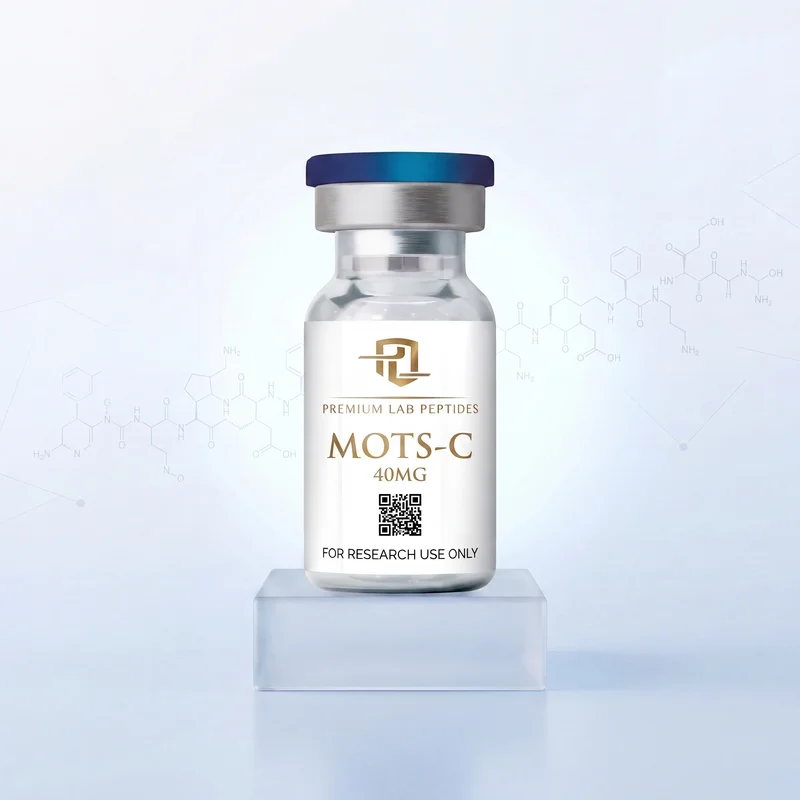
MOTS-c 40mg
MOTS-c 40mg — for in vitro laboratory research use only.
Product Overview
MOTS-c is a pharmaceutical-grade research compound supplied as a lyophilized powder. Each batch undergoes independent third-party testing with a Certificate of Analysis (COA) available on request.
Specifications
| CAS Number | 1627580-64-6 |
| Molecular Formula | C101H152N28O22S2 |
| Molar Weight | ~2174.64 g/mol |
| Sequence | Met-Arg-Trp-Gln-Glu-Met-Gly-Tyr-Ile-Phe-Tyr-Pro-Arg-Lys-Leu-Arg (16 aa) |
| Classification | Mitochondrial-derived peptide (MDP); encoded within the mitochondrial 12S rRNA gene |
| Appearance | White to off-white lyophilised powder (typical presentation) |
| Solubility | Soluble in sterile water or bacteriostatic water |
| Storage | Store lyophilised powder desiccated and protected from light at -20°C. Once reconstituted, store at 2-8°C for short-term use and avoid repeated freeze-thaw cycles. |
| Shelf Life | Typically stable for up to 24 months when stored lyophilised, desiccated, and protected from light at -20°C — confirm against the specific batch's Certificate of Analysis. |
Description & Mechanism of Action
MOTS-c is a 16-amino-acid peptide encoded within the mitochondrial 12S rRNA gene, making it one of a small family of mitochondrial-derived peptides. Under conditions of metabolic stress, MOTS-c has been shown to translocate from the mitochondria to the nucleus via folate receptor 1 (FOLR1), where it appears to act as a transcriptional regulator. Its primary downstream signalling mechanism runs through the folate-AICAR pathway: MOTS-c is reported to inhibit de novo purine synthesis, reducing methyleneTHF availability and driving the accumulation of AICAR, a well-characterised activator of AMP-activated protein kinase (AMPK). Through this route, MOTS-c research has focused on cellular energy sensing, glucose uptake, and metabolic homeostasis. MOTS-c has been evaluated extensively in cell culture and rodent models but has not completed controlled human efficacy trials.
Applications in Research
- Studying mitochondrial-nuclear communication and retrograde signalling
- Investigating AMPK-pathway activation and cellular energy sensing
- Metabolic research models examining glucose uptake and insulin sensitivity
- Exercise-adaptation and age-related metabolic decline research
Handling, Reconstitution & Stability
- Handle as a hygroscopic powder; open vials and weigh under dry conditions where possible
- Reconstitute with sterile water or bacteriostatic water, adding solvent slowly down the side of the vial
- Swirl gently to dissolve — avoid vigorous shaking
- Filter-sterilise (e.g. 0.22 µm) immediately before use if required by your protocol
- Aliquot reconstituted solution and store at -20°C or below; avoid repeated freeze-thaw cycles
Precautions & Notes
- Mechanism is based on preclinical and in-vitro research; no completed human efficacy trials exist to date
- Experimental effects are concentration-, duration-, and model-dependent
- Include appropriate experimental controls to distinguish specific from non-specific effects
- For laboratory research use only — not for human or veterinary use
This product is supplied for in vitro research purposes only. It is not intended for human or animal administration, diagnostic use, or any other purpose. Handle in accordance with good laboratory practice guidelines.
References
- Lee C, et al. "The Mitochondrial-Derived Peptide MOTS-c Promotes Metabolic Homeostasis and Reduces Obesity and Insulin Resistance." Cell Metabolism, 2015.
- "The Mitochondrial-Encoded Peptide MOTS-c Translocates to the Nucleus to Regulate Nuclear Gene Expression in Response to Metabolic Stress." Cell Metabolism, 2018.