
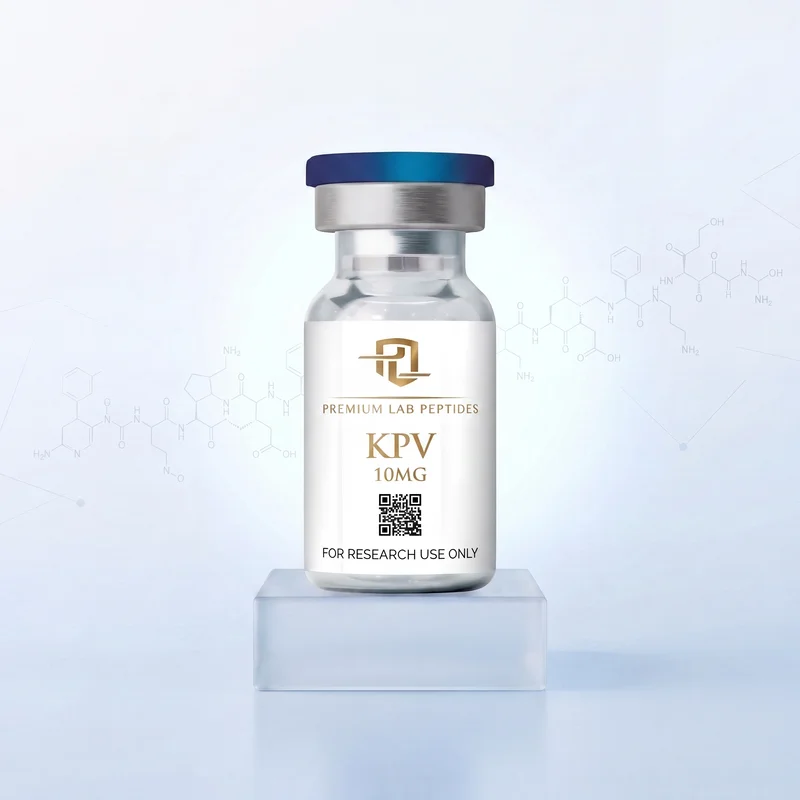
KPV 10mg
KPV 10mg — for in vitro laboratory research use only.
Product Overview
KPV is a pharmaceutical-grade research compound supplied as a lyophilized powder. Each batch undergoes independent third-party testing with a Certificate of Analysis (COA) available on request.
Specifications
| CAS Number | 67727-97-3 |
| Molecular Formula | C16H30N4O4 |
| Molar Weight | ~342.44 g/mol |
| Sequence | Lys-Pro-Val (H-Lys-Pro-Val-OH) |
| Classification | Synthetic tripeptide; C-terminal fragment of α-MSH (α-MSH 11–13) |
| Appearance | White to off-white lyophilised powder (typical presentation) |
| Solubility | Soluble in sterile water or bacteriostatic water |
| Storage | Store lyophilised powder desiccated and protected from light at -20°C. Once reconstituted, store at 2-8°C for short-term use and avoid repeated freeze-thaw cycles. |
| Shelf Life | Typically stable for up to 24 months when stored lyophilised, desiccated, and protected from light at -20°C — confirm against the specific batch's Certificate of Analysis. |
Description & Mechanism of Action
KPV is a tripeptide corresponding to the three C-terminal residues (Lys-Pro-Val) of α-melanocyte-stimulating hormone (α-MSH), representing the minimal fragment reported to retain much of the parent hormone's anti-inflammatory activity in research models. Because it lacks the receptor-binding core found in full-length α-MSH, KPV does not appreciably bind classical melanocortin receptors or raise intracellular cAMP, which has made it a useful tool for researchers studying anti-inflammatory signalling separately from melanocortin receptor activation. In vitro and animal studies have examined its effect on NF-κB, a transcription factor central to inflammatory gene expression, with reported effects on cytokine expression in models of gut and skin inflammation. As with other short bioactive fragments, its behaviour in experimental systems depends on concentration, exposure duration, and the specific model used, and findings to date should be read as exploratory rather than as evidence of a defined physiological effect in humans.
Applications in Research
- Molecular probe for studying melanocortin-related and receptor-independent inflammatory signalling
- Investigating NF-κB-mediated modulation of inflammatory and immune-associated cellular responses
- In vitro models of gut and skin inflammation
- Reference compound in structure-activity studies of α-MSH-derived fragments
Handling, Reconstitution & Stability
- Handle as a hygroscopic powder; open vials and weigh under dry conditions where possible
- Reconstitute with sterile water or bacteriostatic water, adding solvent slowly down the side of the vial rather than directly onto the powder
- Swirl gently to dissolve — avoid vigorous shaking
- Filter-sterilise (e.g. 0.22 µm) immediately before use if required by your protocol
- Aliquot reconstituted solution and store at -20°C or below; avoid repeated freeze-thaw cycles
Precautions & Notes
- Experimental effects are concentration-, duration-, and model-dependent — results should not be extrapolated beyond the specific conditions tested
- Short peptide fragments can show signalling profiles distinct from their parent hormone; do not assume equivalence to full-length α-MSH
- Buffer composition, pH, and ionic strength may affect peptide stability and assay performance
- Include appropriate experimental controls to distinguish specific from non-specific effects
- For laboratory research use only — not for human or veterinary use
This product is supplied for in vitro research purposes only. It is not intended for human or animal administration, diagnostic use, or any other purpose. Handle in accordance with good laboratory practice guidelines.
References
- Getting SJ, et al. "The melanocortin peptide KPV inhibits inflammatory signalling pathways independently of classical melanocortin receptors." Journal of Immunology, 2002.
- Catania A, et al. "The neuroimmunomodulatory role of melanocortins." Endocrine Reviews, 2004.
- Lipton JM, Catania A. "Anti-inflammatory actions of the neuroimmunomodulator α-MSH." Immunology Today, 1997.