
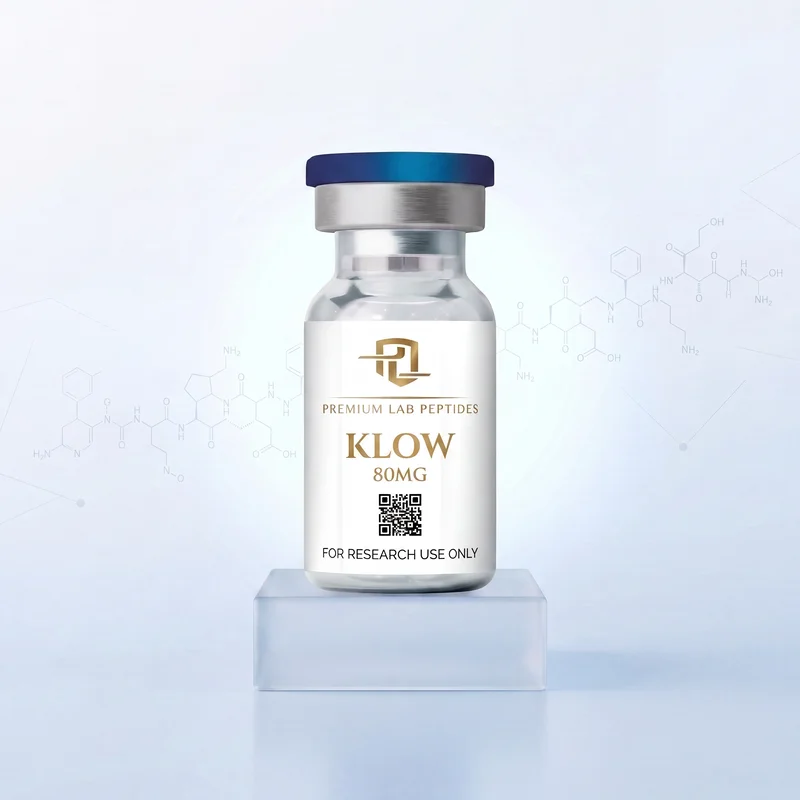
KLOW 80mg
KLOW 80mg — for in vitro laboratory research use only.
Product Overview
KLOW is a pharmaceutical-grade research compound supplied as a lyophilized powder. Each batch undergoes independent third-party testing with a Certificate of Analysis (COA) available on request.
Specifications
| Sequence | GHK-Cu: Gly-His-Lys (Cu-chelated); BPC-157: 15 aa gastric-derived fragment; TB-500: peptide related to Thymosin Beta-4; KPV: Lys-Pro-Val |
| Classification | Four-peptide research blend: GHK-Cu, BPC-157, TB-500, KPV |
| Appearance | White to pale blue-tinted lyophilised powder (tint reflects the GHK-Cu component's copper content) |
| Solubility | Soluble in sterile water or bacteriostatic water |
| Storage | Store lyophilised powder desiccated and protected from light at -20°C. Once reconstituted, store at 2-8°C for short-term use and avoid repeated freeze-thaw cycles. |
| Shelf Life | Typically stable for up to 24 months when stored lyophilised, desiccated, and protected from light at -20°C — confirm against the specific batch's Certificate of Analysis. |
Description & Mechanism of Action
KLOW combines four peptides studied for complementary roles in tissue repair and inflammation control. GHK-Cu, a copper-binding tripeptide, delivers copper to key enzymes and activates TGF-β signalling to support collagen and elastin synthesis. BPC-157, a gastric-derived pentadecapeptide, is studied for promoting angiogenesis via the VEGFR2 pathway. TB-500-related peptides are studied for actin-mediated regulation of cell migration, supporting movement of repair cells toward damaged tissue. KPV, a tripeptide corresponding to the C-terminal fragment of α-melanocyte-stimulating hormone, has been studied for inhibiting NF-κB signalling and reducing pro-inflammatory cytokine expression independently of classical melanocortin receptors. Together, these four complementary mechanisms are of research interest for their combined potential effect on tissue remodelling alongside inflammation control. As with other combined-peptide blends, the four-component formulation itself has not been directly evaluated in controlled human trials — each peptide has primarily been studied individually.
Applications in Research
- Multi-pathway tissue-repair and inflammation research models
- Comparative studies of collagen synthesis (GHK-Cu), angiogenesis (BPC-157), cell migration (TB-500), and NF-κB inhibition (KPV)
- Skin, gut, and connective-tissue inflammation research
- Reference blend for studying combined versus individual peptide signalling
Handling, Reconstitution & Stability
- Handle as a hygroscopic powder; open vials and weigh under dry conditions where possible
- Reconstitute with sterile water or bacteriostatic water, adding solvent slowly down the side of the vial
- A blue or blue-green tint in solution is expected, reflecting the GHK-Cu component's bound copper content
- Filter-sterilise (e.g. 0.22 µm) immediately before use if required by your protocol
- Aliquot reconstituted solution and store at -20°C or below; avoid repeated freeze-thaw cycles
Precautions & Notes
- This is a four-peptide blend; the combined formulation has not been directly evaluated in controlled human trials
- Peptides marketed as "TB-500" vary in composition between suppliers — confirm against your product's Certificate of Analysis
- Experimental effects are concentration-, duration-, and model-dependent
- For laboratory research use only — not for human or veterinary use
This product is supplied for in vitro research purposes only. It is not intended for human or animal administration, diagnostic use, or any other purpose. Handle in accordance with good laboratory practice guidelines.
References
- Pickart L, Margolina A. "Regenerative and Protective Actions of the GHK-Cu Peptide in the Light of the New Gene Data." International Journal of Molecular Sciences, 2018.
- Getting SJ, et al. "The melanocortin peptide KPV inhibits inflammatory signalling pathways independently of classical melanocortin receptors." Journal of Immunology, 2002.