
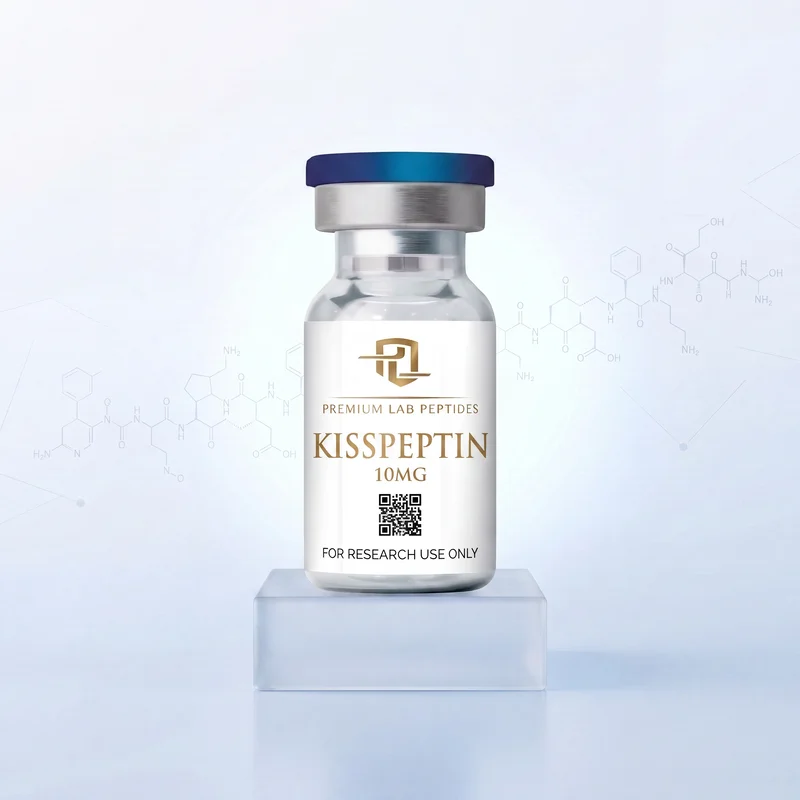
Kisspeptin 10mg
Kisspeptin 10mg — for in vitro laboratory research use only.
Product Overview
Kisspeptin is a pharmaceutical-grade research compound supplied as a lyophilized powder. Each batch undergoes independent third-party testing with a Certificate of Analysis (COA) available on request.
Specifications
| CAS Number | 374675-21-5 |
| Molecular Formula | C63H83N17O14 |
| Molar Weight | ~1302.45 g/mol |
| Sequence | Tyr-Asn-Trp-Asn-Ser-Phe-Gly-Leu-Arg-Phe-NH2 (Kisspeptin-10) |
| Classification | Neuropeptide; KISS1-gene-derived decapeptide fragment, KISS1R (GPR54) agonist |
| Appearance | White to off-white lyophilised powder (typical presentation) |
| Solubility | Soluble in sterile water or bacteriostatic water |
| Storage | Store lyophilised powder desiccated and protected from light at -20°C. Once reconstituted, store at 2-8°C for short-term use and avoid repeated freeze-thaw cycles. |
| Shelf Life | Typically stable for up to 24 months when stored lyophilised, desiccated, and protected from light at -20°C — confirm against the specific batch's Certificate of Analysis. |
Description & Mechanism of Action
Kisspeptin is a neuropeptide family encoded by the KISS1 gene; the form typically used in research is Kisspeptin-10, the shorter, active C-terminal fragment. Kisspeptin neurons in the hypothalamic arcuate nucleus (ARC) and anteroventral periventricular nucleus (AVPV) signal directly to GnRH-secreting neurons via the KISS1R receptor (also known as GPR54), a G-protein coupled receptor. Receptor activation triggers pulsatile release of gonadotropin-releasing hormone (GnRH) into the hypophyseal portal system, driving anterior pituitary secretion of LH and FSH, which in turn stimulate the gonads to produce testosterone (in males) or drive follicular development and ovulation (in females). Regulation of this axis is bidirectional: testosterone and estrogen normally suppress ARC kisspeptin neuron activity as negative feedback, while estrogen paradoxically stimulates the AVPV population to trigger the pre-ovulatory LH surge. Because kisspeptin acts upstream of GnRH, it has drawn research interest as a potential way to stimulate the body's own testosterone production without the negative feedback suppression associated with exogenous testosterone administration.
Applications in Research
- Studying the hypothalamic-pituitary-gonadal (HPG) axis and GnRH pulse generation
- KISS1R (GPR54) receptor pharmacology research
- Reproductive endocrinology and fertility research models
- Investigating pubertal-onset regulation
Handling, Reconstitution & Stability
- Handle as a hygroscopic powder; open vials and weigh under dry conditions where possible
- Reconstitute with sterile water or bacteriostatic water, adding solvent slowly down the side of the vial
- Swirl gently to dissolve — avoid vigorous shaking
- Filter-sterilise (e.g. 0.22 µm) immediately before use if required by your protocol
- Aliquot reconstituted solution and store at -20°C or below; avoid repeated freeze-thaw cycles
Precautions & Notes
- Human data is more established for kisspeptin's role in fertility/reproductive research than for other applications
- Experimental effects are concentration-, duration-, and model-dependent
- Include appropriate experimental controls to distinguish specific from non-specific effects
- For laboratory research use only — not for human or veterinary use
This product is supplied for in vitro research purposes only. It is not intended for human or animal administration, diagnostic use, or any other purpose. Handle in accordance with good laboratory practice guidelines.