
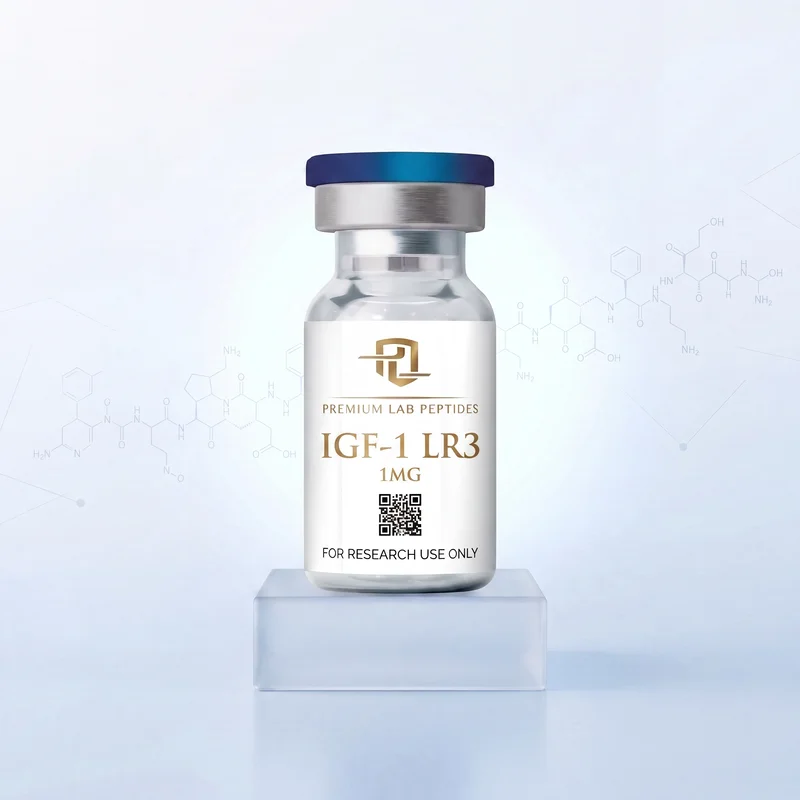
IGF-1 LR3 1mg
IGF-1 LR3 1mg — for in vitro laboratory research use only.
Product Overview
IGF-1 LR3 is a pharmaceutical-grade research compound supplied as a lyophilized powder. Each batch undergoes independent third-party testing with a Certificate of Analysis (COA) available on request.
Specifications
| CAS Number | 946870-92-4 |
| Molecular Formula | C400H625N111O115S9 |
| Molar Weight | ~9117.5 g/mol (~9.1 kDa) |
| Sequence | 83-amino-acid analog of native IGF-1, with an Arg-for-Glu substitution at position 3 and an additional 13-amino-acid N-terminal extension |
| Classification | Laboratory-modified analog of Insulin-like Growth Factor 1 (IGF-1); IGF-1 receptor (IGF-1R) agonist |
| Appearance | White to off-white lyophilised powder (typical presentation) |
| Solubility | Soluble in sterile water, dilute acetic acid, or manufacturer-recommended buffer |
| Storage | Store lyophilised powder desiccated and protected from light at -20°C (or -80°C per supplier guidance for extended storage, as some recombinant proteins are less stable than short peptides). Once reconstituted, store at 2-8°C for short-term use and avoid repeated freeze-thaw cycles. |
| Shelf Life | Typically stable for up to 24 months when stored lyophilised, desiccated, and protected from light at -20°C — confirm against the specific batch's Certificate of Analysis, as recombinant proteins can be more storage-sensitive than short synthetic peptides. |
Description & Mechanism of Action
IGF-1 LR3 is a laboratory-modified analog of Insulin-like Growth Factor 1, engineered with an arginine substitution at position 3 and an additional 13-amino-acid extension at the N-terminus. These structural changes dramatically reduce its binding affinity for IGF binding proteins (IGFBPs) — which normally sequester native IGF-1 in the bloodstream and limit its bioavailability — leaving substantially more IGF-1 LR3 free and biologically active in circulation compared to native IGF-1. Free IGF-1 LR3 binds the IGF-1 receptor (IGF-1R), a receptor tyrosine kinase expressed on muscle, bone, and fat cells, triggering receptor autophosphorylation and activating two major downstream cascades: the PI3K/Akt pathway, associated with protein synthesis and cell survival (Akt phosphorylation has been reported within 5-15 minutes of exposure in cell models), and the MAPK/ERK pathway, associated with cell proliferation and differentiation. Its extended bioavailability relative to native IGF-1 is what distinguishes its research profile.
Applications in Research
- Studying IGF-1 receptor (IGF-1R) activation and downstream PI3K/Akt and MAPK/ERK signalling
- Myocyte and skeletal muscle cell model research
- Comparative bioavailability research versus native IGF-1 (IGFBP-binding studies)
- Cell proliferation and protein synthesis research models
Handling, Reconstitution & Stability
- As a larger recombinant protein rather than a short synthetic peptide, handle with extra care to avoid denaturation — avoid vigorous shaking or vortexing
- Reconstitute with sterile water, dilute acetic acid, or manufacturer-recommended buffer depending on your protocol; add solvent slowly down the side of the vial
- Filter-sterilise (e.g. 0.22 µm) immediately before use if required by your protocol
- Aliquot reconstituted solution to avoid repeated freeze-thaw cycles, and store at -20°C or below (or -80°C per supplier guidance)
Precautions & Notes
- IGF-1 LR3 is a laboratory-modified research analog, not an approved pharmaceutical
- Experimental effects are concentration-, duration-, and model-dependent
- Include appropriate experimental controls to distinguish specific from non-specific effects
- For laboratory research use only — not for human or veterinary use
This product is supplied for in vitro research purposes only. It is not intended for human or animal administration, diagnostic use, or any other purpose. Handle in accordance with good laboratory practice guidelines.