
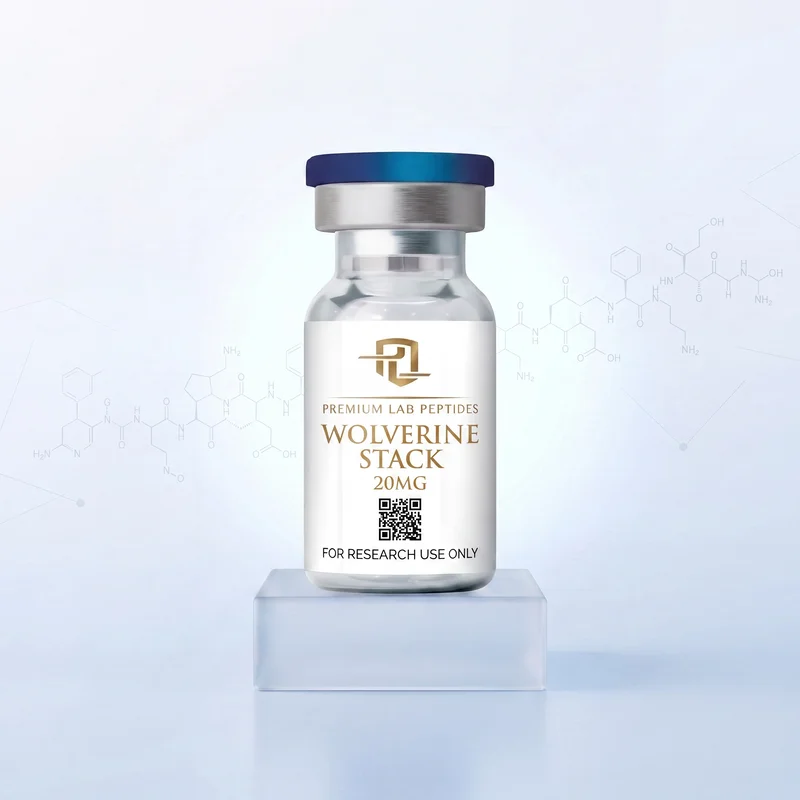
BPC157 + TB500 Blend 10mg/10mg
BPC157 + TB500 Blend 10mg/10mg — for in vitro laboratory research use only.
Product Overview
BPC157 + TB500 Blend is a pharmaceutical-grade research compound supplied as a lyophilized powder. Each batch undergoes independent third-party testing with a Certificate of Analysis (COA) available on request.
Specifications
| Sequence | BPC-157: Gly-Glu-Pro-Pro-Pro-Gly-Lys-Pro-Ala-Asp-Asp-Ala-Gly-Leu-Val (15 aa); TB-500: peptide related to Thymosin Beta-4 |
| Classification | Two-peptide research blend: BPC-157 + TB-500 (1:1 ratio) |
| Appearance | White to off-white lyophilised powder (typical presentation) |
| Solubility | Soluble in sterile water or bacteriostatic water |
| Storage | Store lyophilised powder desiccated and protected from light at -20°C. Once reconstituted, store at 2-8°C for short-term use and avoid repeated freeze-thaw cycles. |
| Shelf Life | Typically stable for up to 24 months when stored lyophilised, desiccated, and protected from light at -20°C — confirm against the specific batch's Certificate of Analysis. |
Description & Mechanism of Action
Wolverine Stack combines two peptides studied for complementary roles in soft-tissue repair: BPC-157, a 15-amino-acid fragment derived from a human gastric juice protein, and TB-500, commonly described as a peptide related to Thymosin Beta-4, a naturally occurring actin-regulating protein. In preclinical research, BPC-157 has been studied for its interaction with the VEGFR2 pathway, promoting angiogenesis, and for modulating nitric oxide signalling at sites of tissue damage. TB-500-related peptides are studied for their role in regulating actin dynamics within cells, a mechanism believed to support the migration of endothelial cells, keratinocytes, and stem cells toward an injury site. Together, these complementary pathways are of research interest for their potential combined effect on angiogenesis, cell migration, and tissue remodelling. Note that "TB-500" is used inconsistently across suppliers — some products sold under this name contain the full 43-amino-acid Thymosin Beta-4 rather than a smaller synthetic fragment — so composition should always be confirmed against the product's own Certificate of Analysis. The combined blend itself has not been directly evaluated in controlled human trials; each peptide has primarily been studied individually in animal and in-vitro models.
Applications in Research
- Studying VEGFR2-mediated angiogenesis in tissue-repair models
- Investigating actin-regulated cell migration in wound-healing research
- Combined-pathway research into soft-tissue and tendon/ligament repair models
- Comparative research on gastric-derived versus thymosin-derived peptide mechanisms
Handling, Reconstitution & Stability
- Handle as a hygroscopic powder; open vials and weigh under dry conditions where possible
- Reconstitute with sterile water or bacteriostatic water, adding solvent slowly down the side of the vial
- Swirl gently to dissolve — avoid vigorous shaking
- Filter-sterilise (e.g. 0.22 µm) immediately before use if required by your protocol
- Aliquot reconstituted solution and store at -20°C or below; avoid repeated freeze-thaw cycles
Precautions & Notes
- This is a two-peptide blend; the combined formulation has not been directly evaluated in controlled human trials
- Peptides marketed as "TB-500" vary in composition between suppliers — confirm the actual sequence/purity against your product's Certificate of Analysis
- Experimental effects are concentration-, duration-, and model-dependent
- For laboratory research use only — not for human or veterinary use
This product is supplied for in vitro research purposes only. It is not intended for human or animal administration, diagnostic use, or any other purpose. Handle in accordance with good laboratory practice guidelines.
References
- Sikiric P, et al. "Novel Cytoprotective Mediator, Stable Gastric Pentadecapeptide BPC 157. Vascular Recruitment and Gastrointestinal Tract Healing." Current Pharmaceutical Design, 2018.
- Goldstein AL, Hannappel E, Sosne G, Kleinman HK. "Thymosin β4: a multi-functional regenerative peptide. Basic properties and clinical applications." Expert Opinion on Biological Therapy, 2012.