
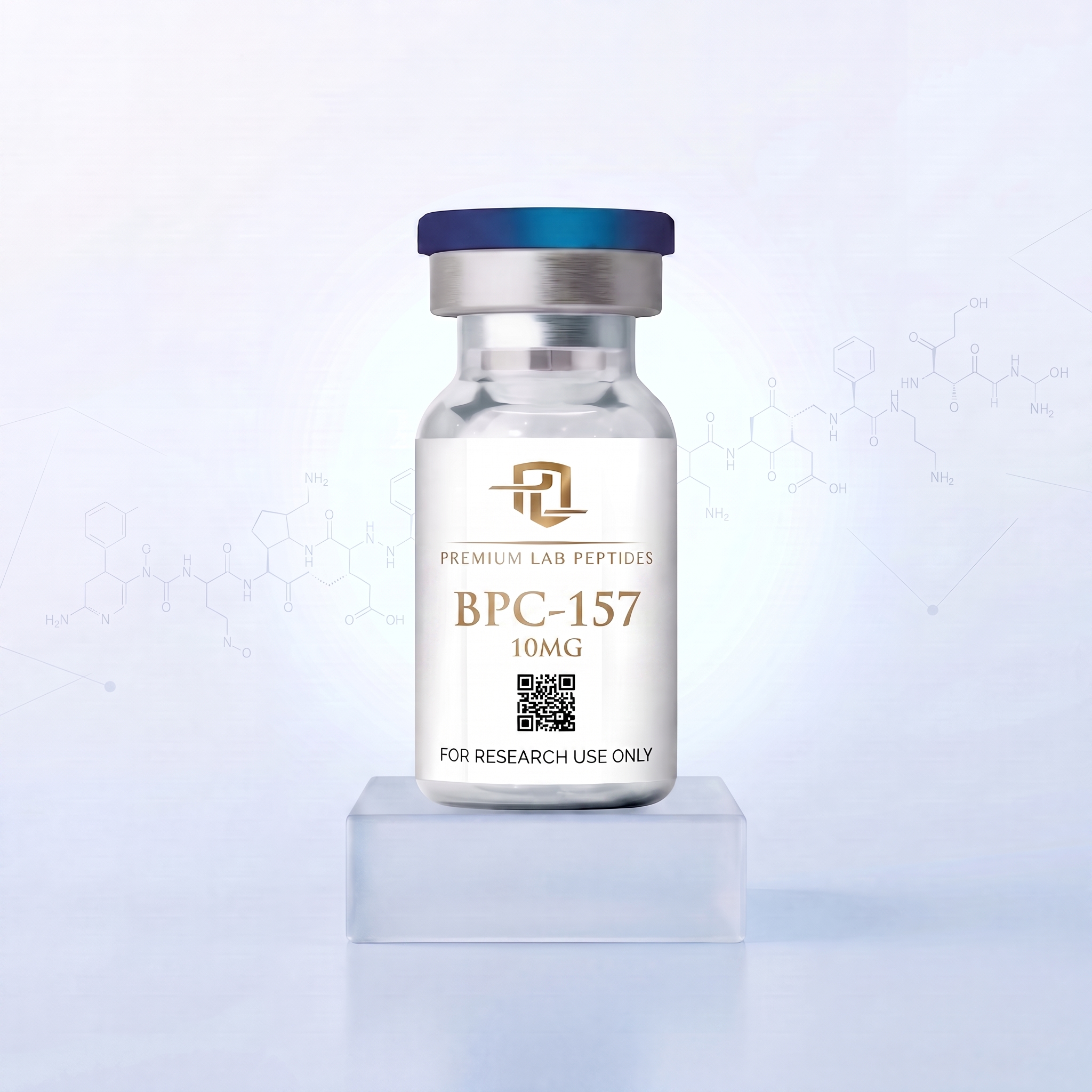
BPC-157 10mg
BPC-157 10mg — for in vitro laboratory research use only.
Product Overview
BPC-157 is a pharmaceutical-grade research compound supplied as a lyophilized powder. Each batch undergoes independent third-party testing with a Certificate of Analysis (COA) available on request.
Specifications
| CAS Number | 137525-51-0 |
| Molecular Formula | C62H98N16O22 |
| Molar Weight | 1419.54 |
| Sequence | Gly-Glu-Pro-Pro-Pro-Gly-Lys-Pro-Ala-Asp-Asp-Ala-Gly-Leu-Val (15 aa) |
| Classification | Synthetic pentadecapeptide; partial sequence of Body Protection Compound, a protein identified in human gastric juice |
| Appearance | White to off-white lyophilised powder (typical presentation) |
| Solubility | Soluble in sterile water or bacteriostatic water |
| Storage | Store lyophilised powder desiccated and protected from light at -20C. Once reconstituted, store at 2-8C for short-term use and avoid repeated freeze-thaw cycles. |
| Shelf Life | Typically stable for up to 24 months when stored lyophilised, desiccated, and protected from light at -20C. Confirm against the specific batch Certificate of Analysis. |
Description & Mechanism of Action
BPC-157 is a synthetic 15-amino-acid peptide corresponding to a partial sequence of Body Protection Compound, a protein identified in human gastric juice. Preclinical research has examined its interaction with the VEGFR2 pathway and associated angiogenic signalling, and its modulation of nitric oxide production at sites of tissue damage. Animal and cell-culture models have investigated effects on fibroblast migration, collagen organisation, and gastrointestinal mucosal integrity. The peptide is reported to be comparatively stable in gastric juice, which has made it of interest in oral-administration research models. Two limitations are worth noting when interpreting the literature: BPC-157 has not been approved as a medicine in any jurisdiction and has not been evaluated in large controlled human trials, and a substantial proportion of the published work originates from a small number of research groups, which constrains how far the findings can currently be generalised.
Applications in Research
- Studying VEGFR2-mediated angiogenesis in tissue-repair models
- Investigating fibroblast migration and collagen organisation in wound-healing research
- Gastrointestinal mucosal integrity research models
- Stability research in low-pH and simulated gastric environments
Handling, Reconstitution & Stability
- Handle as a hygroscopic powder; open vials and weigh under dry conditions where possible
- Reconstitute with sterile water or bacteriostatic water, adding solvent slowly down the side of the vial
- Swirl gently to dissolve. Avoid vigorous shaking.
- Filter-sterilise (0.22 micron) immediately before use if required by your protocol
- Aliquot reconstituted solution and store at -20C or below; avoid repeated freeze-thaw cycles
Precautions & Notes
- Not approved as a medicine in any jurisdiction and not evaluated in large controlled human trials
- Much of the published literature originates from a small number of research groups. Interpret accordingly.
- Experimental effects are concentration-, duration-, and model-dependent
- For laboratory research use only. Not for human or veterinary use.
This product is supplied for in vitro research purposes only. It is not intended for human or animal administration, diagnostic use, or any other purpose. Handle in accordance with good laboratory practice guidelines.